
Journalism Ethics Quiz - When an Eagle Biologist Asked Me Not to Mention a Jarring Detail

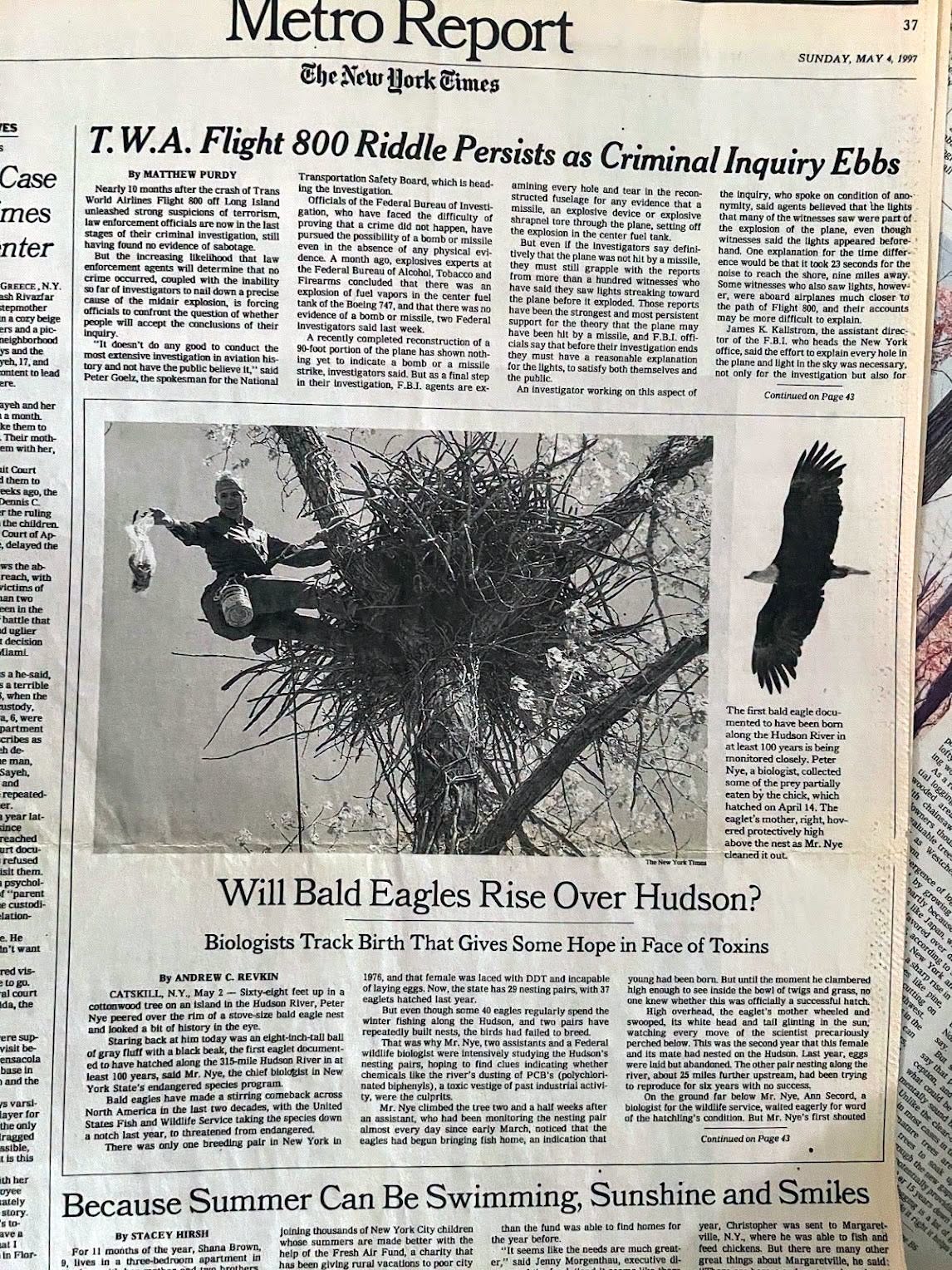
I just came across this photo I shot of a May 1997 New York Times layout while going through my heaps of clippings before we moved to Maine in 2022.
The story about the investigation of the catastrophic 1996 explosion on TWA Flight 800 by my friend Matt Purdy jogged me because I spent months reporting on that dark riddle. There were plenty of lessons about journalism there!
But I’m posting about journalism practices and norms today because I also found myself recalling that Pete Nye, the eagle biologist climbing up trees in the Hudson Valley to check on eagle nestlings’ condition, asked me not to mention something: the cat collars he regularly found in the nests.
Did I self censor? Should I have? Read the story (paywall free link) to find out and then weigh in - in the poll, but ideally also with a comment. I will respond on Tuesday.
Here’s the story opener:
Sixty-eight feet up in a cottonwood tree on an island in the Hudson River, Peter Nye peered over the rim of a stove-size bald eagle nest and looked a bit of history in the eye.
Staring back at him today was an eight-inch-tall ball of gray fluff with a black beak, the first eaglet documented to have hatched along the 315-mile Hudson River in at least 100 years, said Mr. Nye, the chief biologist in New York State’s endangered species program.
Bald eagles have made a stirring comeback across North America in the last two decades, with the United States Fish and Wildlife Service taking the species down a notch last year, to threatened from endangered.
There was only one breeding pair in all of New York State in 1976, and that female was laced with DDT and incapable of laying eggs.
Now, there are 29 nesting pairs, and 37 eaglets were hatched in the state last year, although none in the Hudson Valley.
Some 40 eagles regularly spend the winter fishing along the Hudson, and two pairs had repeatedly built nests, but the birds failed to breed. That was why Mr. Nye, two assistants and a Federal wildlife biologist were intensively studying the Hudson’s nesting pairs, hoping to find clues indicating whether chemicals like the river’s dusting of PCB’s (polychlorinated biphenyls), a toxic vestige of past industrial activity, were the culprits.
Mr. Nye climbed the tree two and a half weeks after an assistant, who had been monitoring the nesting pair almost every day since early March, noticed that the eagles had begun bringing fish home, an indication of young life in the nest.
But until the moment Mr. Nye clambered high enough to see inside the bowl of twigs and grass, no one knew whether this was officially a successful hatch.
So read the rest and let me know your answer to the Journalism 101 question. Comments are usually restricted to paying subscribers but I’ve opened them to all today.
And do consider chipping in to help me justify the time it takes to sustain Sustain What.
This essay (based on a lecture) describes how I balanced passion for the enviroment with detachment covering it:
Can There Be Passion and Detachment in Environmental Journalism?

I want to give newcomers to my journey a bit of context on why I got into journalism in the first place and how I pursue this practice. I first posted a version of this lecture summary in 2010 on my Dot Earth blog at The New York Times but want it to be outside the paywall here as well. Weigh in with your reactions.
If you were going to include it without providing any additional context my answer would be yes, you were right to leave it out. It might provoke an emotional response by some readers without understanding the broader ecosystem risks. But if you included additional text about the disproportionate deaths of birds BY cats and how that has disrupted the ecosystem, then no, you shouldn’t have left it out.
To be fair, you might not have had access to much data on bird deaths by cats to provide that context in 1997. We know a lot more now.
I would’ve done a second story about the cat collars. It’s a dodge but it’s news people ought to know.