

Facing Momentous Warnings, from AI to Climate, Find Meaning and Value Here and Now
Andrew Maynard offered advice for doom-focused folks as we explored Pope Leo XIV's AI manifesto

I think a lot about the future, both the ever-louder-ticking clock of my life at age 70 and what lies ahead for our species and the rest of the living world.
Whether it’s a formal geological epoch or not, the Anthropocene, for instance, is just in its baby steps. Any proposal for slowing human-caused climate change (as distinct from reducing climate RISK) is implicitly far more about the future than now.
I’ve had conversations with great future-focused folks like Michele Wucker, Thomas Homer-Dixon and Susan Cox-Smith, Alex Steffen (on predatory delay), Nate Hagens, Ari Wallach (“A Brief History of the Future”) and the planet-focused physicist Adam Frank (more on Adam in a minute).
And, sure, I worry about the future. That’s why I loved this kinetic sculpture, called “Pending,” created in 2010 by a Hudson Valley neighbor, John Allen:
My future fears came out in my exploration Monday of Pope Leo XIV’s encyclical with Brad Allenby and Andrew Maynard of Arizona State University:

As Allenby laid out the darkest prospects — with AI exploited by people like Vladimir Putin — and as we pondered the reality that human intelligence won’t be able to compete with the “alien intelligence” we’re building (Maynard’s term), I brought up a question I’ve long mused about:
Is intelligence ultimately inevitably maladaptive?
I showed them this card I made years ago, pondering the question dogging astrobiologists: Why is the the universe so quiet? (See Fermi Paradox and the Great Filter for more.)
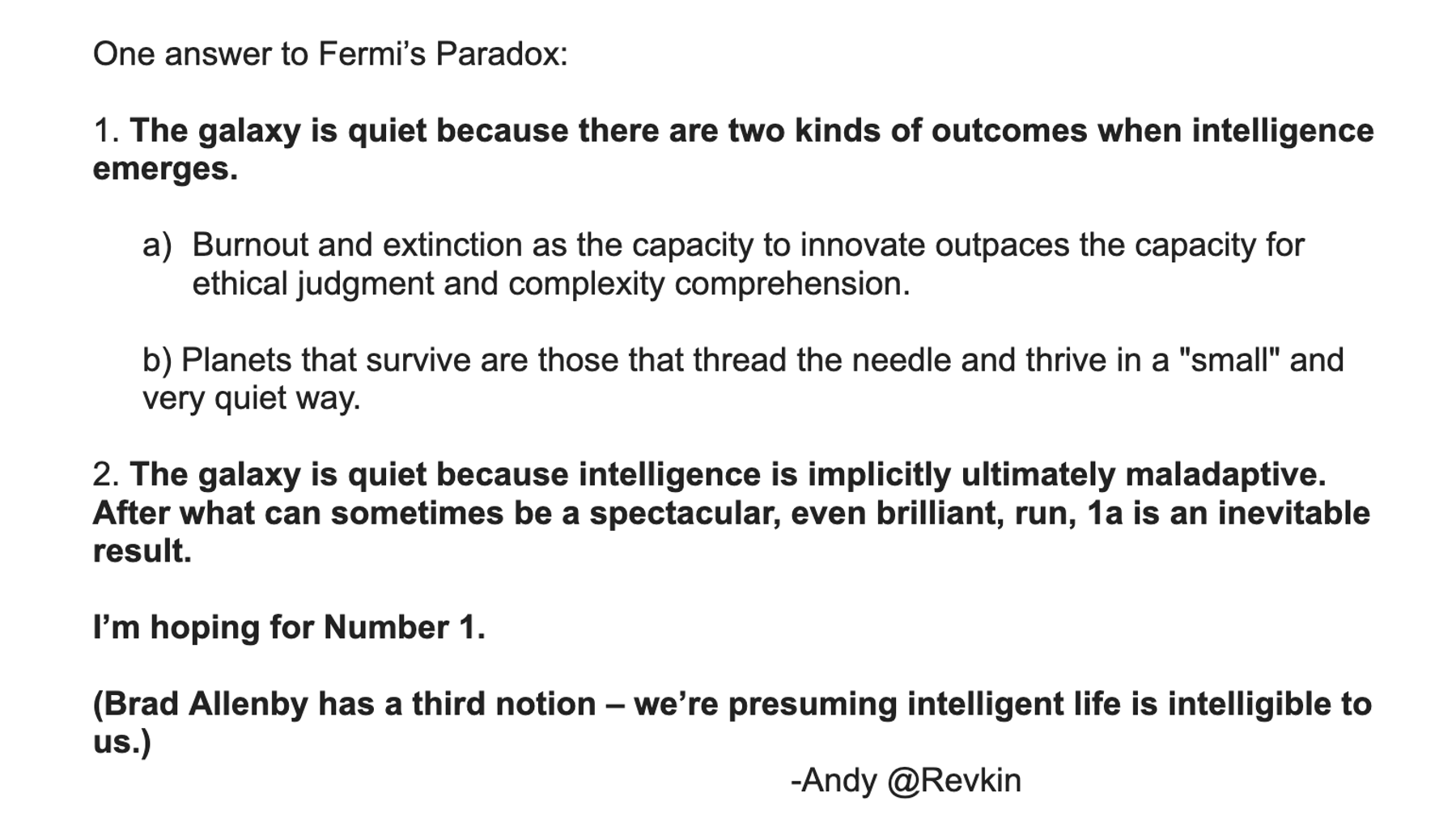
That’s when Andrew Maynard, who writes the The Future of Being Human, weighed in with a statement I find sufficiently valuable that it deserved to be reposted on its own instead of buried deep in yesterday’s piece. Listen or read and weigh in.
I think there’s a very real chance that as a civilization, we will burn out, that we will discover that human exceptionalism means nothing to the universe and to the march of entropy. But I don’t care.
I think what is important, and again, this is just my philosophy, is what it means to be human here and now, what it means to be human in terms of the value we create for ourselves, how we identify worth, how we create value with relationships with others.
That’s not being exceptional. It’s just, to me, being human.
And if you focus on that and the near term, it really doesn’t matter too much what the future of humanity is. Maybe our candle will burn bright and burn out. But the here and now then becomes important. And that, in a sense, is what is reflected in the encyclical.
Not all of it, because the encyclical is wrapped up in a religious sort of bubble that says actually sort of human’s relationship with God and by extension with the universe has primacy here.
I would disagree with that, but I would agree 100% with the fact that you find meaning and value in those relationships in the here and now. And so that actually gives me hope and it gives me excitement when I see what happens with AI, because wherever it goes, if we keep hold of what it means to be human within that, we can continue to create value on our own terms.
I think his view is worth sharing with the many people out there — including many young people — who are somewhat consumed by dire portents like those doled out to young people by the Extinction Rebellion pied piper of doom Roger Hallam.
As promised, here’s something Adam Frank said on Sustain What (and writes about):
Please SHARE this post if you appreciate what I do.
But hasn't the "here and now" always been important. If we pay more attention to that sense of being, we wouldn't mess things up so much... I mean dreaming up these ideas of what we "might" want to exist out there...
Expectations is the word I am looking for... There are too many of them coming from every direction.
I find the Pope's Babel/Jerusalem comparison illuminating for the same reasons I find the Judeo Christian doctrine of the Fall helpful: human intelligence (and therefore AI) go haywire frequently because they are driven largely by the inherent iniquities in humanity