Various updates - Headlines are trying to catch up with the destruction and still-mounting death toll from a monstrous flood that raged down a river valley from Tibet into Nepal early August 26th local time.
Insert, 4:50 p.m., 8/27 - Here’s my Sustain What show on the catastrophe:
x
The unfolding disaster is a reminder that, as I explain below, Young Mountains + Changing Climate + Crowding Valleys = Trouble.
This clip from the following report on India’s Republic television network gives just a hint of the destruction wrought by this event.
Here’s the full TV report, which is a helpful snapshot of what’s known and not known. One issue mentioned by experts in the TV report is poor cross-border communication between the Chinese officials who control Tibet and Nepal’s emergency management offices. Again, it’s too soon to have details.
Insert, 8/26, 11:30 pm Eastern - ICIMOD, the international institution monitoring glacial change in the Himalayas, posted an initial assessment:
Preliminary assessment based on video footage and information from affected areas suggest that a large volume of ice and rock debris may have entered the Lende Khola, a tributary of the Bhote Koshi River. Researchers say the event could have generated a sudden surge that carried water, sediment and large boulders downstream….
Scientists cautioned that while climate change is altering glaciers, snow conditions, permafrost and mountain slopes across the Hindu Kush Himalaya, it is too early to determine what role climate change played in this specific event.
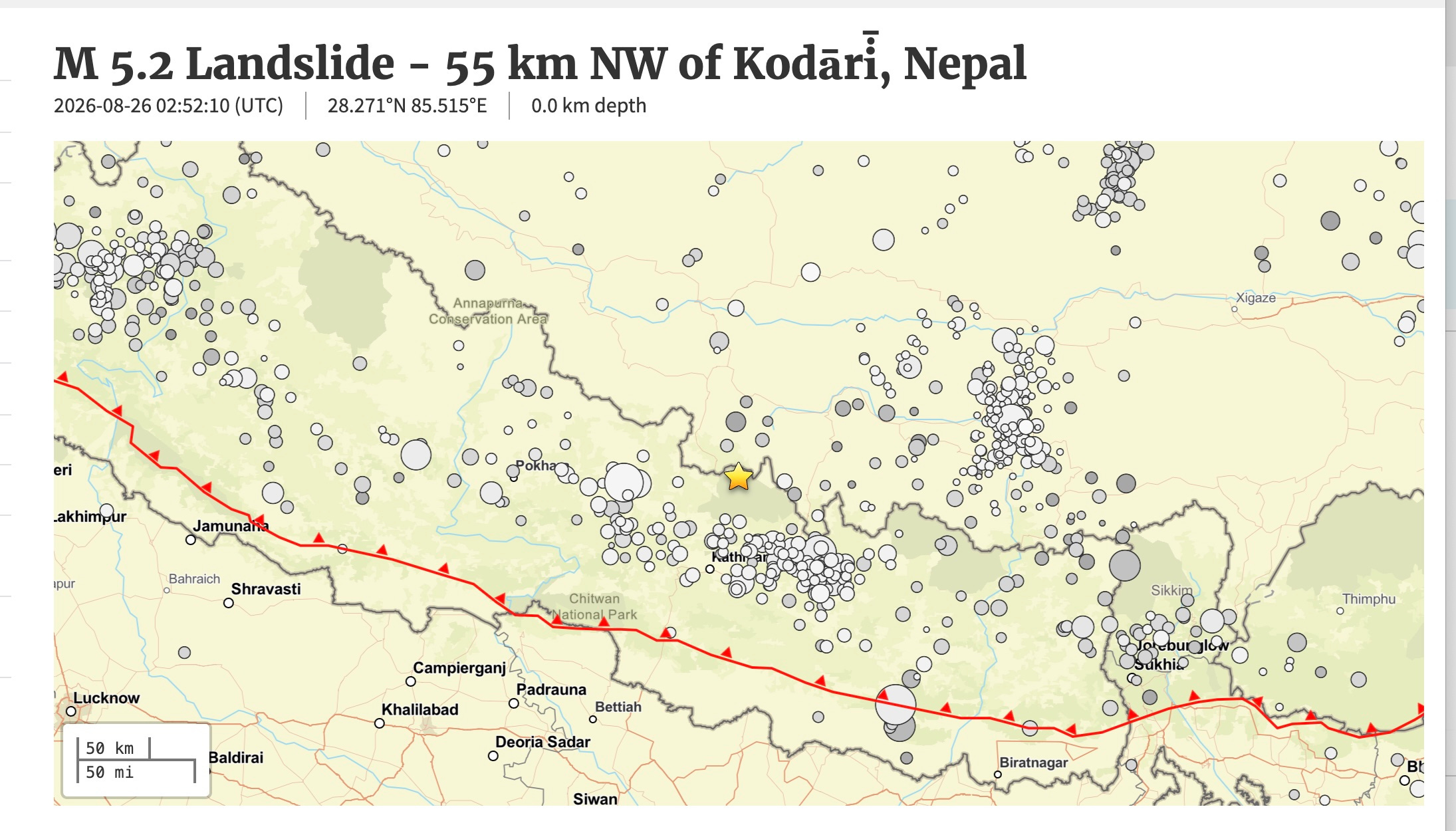
Government officials in Nepal initially cited as a trigger a 4.4-magnitude earthquake reported by the U.S. Geological Survey, but the survey seismologists updated their analysis and concluded the shaking was from a massive landsdlide:
This event was initially reported as a magnitude 4.4 earthquake. Additional analysis of long period seismic waves indicate that the seismic energy was instead generated by a landslide. The location of this event was estimated from satellite images.
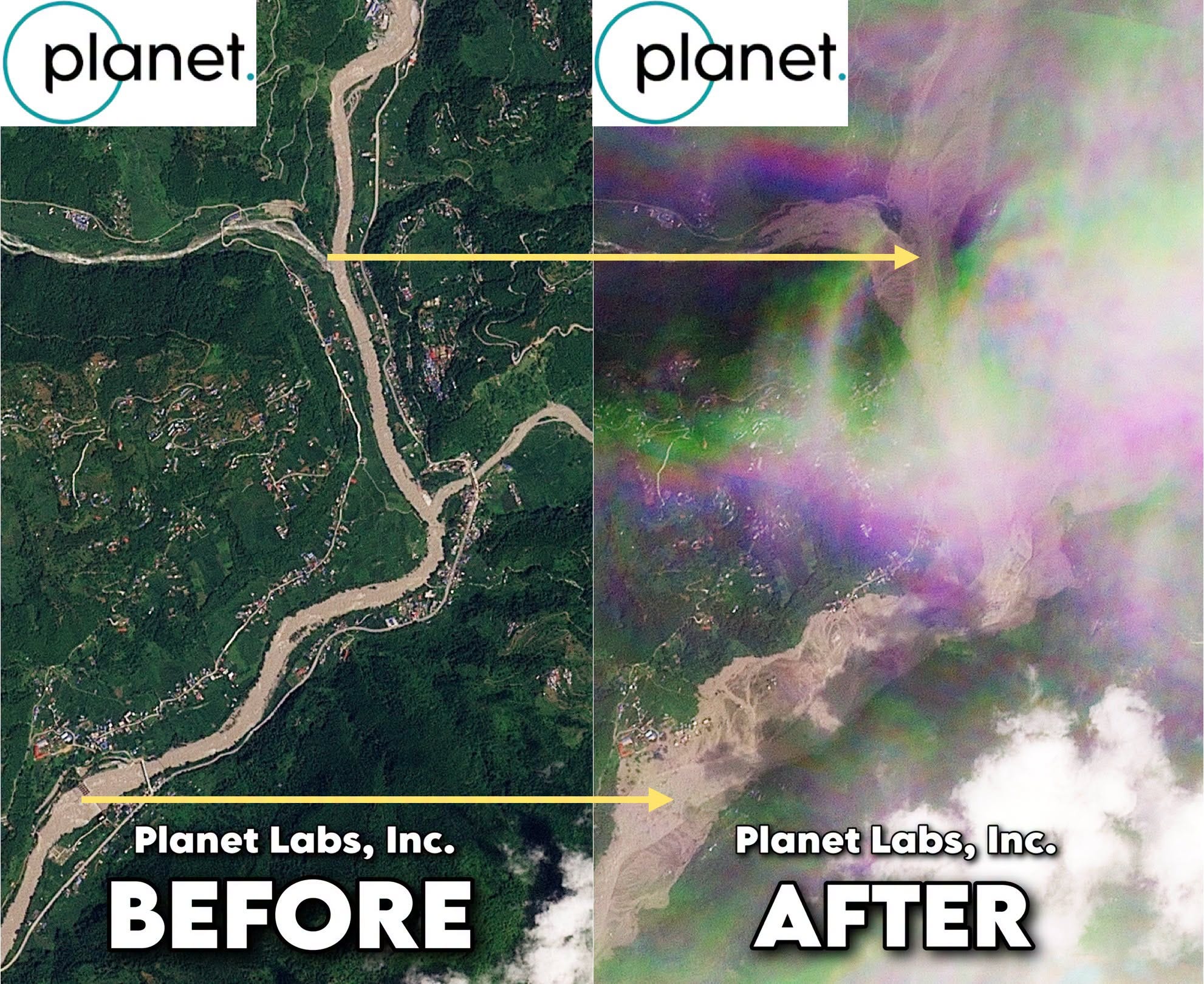
BREAKING: We have our first satellite images of the devastating Nepal/China floods, courtesy of our hardworking friends at Planet Labs, Inc.
This shows the Triushuli River more than quintupling in width and rising by 50-100 feet in some spots. For the hundreds reported missing, and presumed dead, there was simply no warning nor escape.
This is about 40 miles north of Katmandu, the capital of Nepal.
An extreme landslide, equivalent in strength to a magnitude 5.2 earthquake, ruptured with the force of 950 tons of exploding TNT. That was enough to essentially break a natural dam, allowing torrents of water (much of it meltwater from mountain snowpacks that melted over many years, i.e. a glacial lake) to be released.
The Trishuli River is a tributary formed by the merger of the Kyirong Tsangpo and Lende Khola rivers originating in Gyirong County of Tibet.
It’s unclear where the floodwaters came from. There are several large glacial lakes in Shigatse, China. Each occupies its own endorheic basin, meaning there’s no outlet for the lakes’ waters to drain.
It appears a massive chunk of ice from one of the glaciers shifted or broke, opening a glacial lake to drainage into one or more river valleys.
Regardless, floodwaters rushed southwards down the Trishuli River through the Rasuwa District of Bagmati Province, gushing through the river valley and inundating virtually every community along the Pasang Lhamu Highway.
That populous corridor included the Friendship Bridge in Rasuwagadi, where Nepal and China meet. - End insert
For the moment, the key need is search, rescue and aid. I’ll post an update and hopefully will get the great Himalayas-focused journalist Ramesh Bhushal (new to Substack) on Sustain What to discuss the situation. Learn about his new book here:
One reality is crystal clear. Wherever massive amounts of water are stored at high elevations in regions with steep-walled valleys and unstable geology, the threat of catstrophic flooding is a huge challenge. That is as true in Juneau, Alaska, as it is across the “Third Pole” in Asia.
Click back to this Sustain What discussion for the science:
x
The only reason you’re seeing this is because a small percentage of Sustain What subscribers chip in financially. If you can afford it (I know the paywall issue!), thanks for joining them.
Here, back in 2021, I ran another discussion after another awful Himalayan flooding calamity:
Young Mountains + Changing Climate + Crowding Valleys = Trouble
Experts and journalists explore lessons after a catastrophic flood sweeps away dams and people in a Himalayan valley in India - a special news briefing on risk and resilience in a changing, multi-threat landscape, hosted by Andy Revkin.
Ramesh Bhushal, Nepal-based journalist, South Asia coordinator, Earth Journalism Network https://twitter.com/RameshBhushal
Kashish Das Shrestha, writer and sustainability policy analyst https://twitter.com/kashishds
Joydeep Gupta, India-based journalist, director, The Third Pole http://thethirdpole.net
Miriam Matejova, fellow, Norman Paterson School of International Affairs, Carleton University; specializing in global environmental politics, disaster risk and security https://twitter.com/miriammatej
Benjamin Orlove, IPCC author, Columbia U. anthropologist focused on climate & mountain communities, founder of the Glacier Hub blog https://blogs.ei.columbia.edu/2020/05/21/welcome-glacierhub/
Relevant reading:
One-Two Punch of Earthquakes and Landslides Exposes Hydropower Vulnerability in Nepal https://nyti.ms/36WpBTX (2015 Dot Earth post by Kashish Das Shreshtha and Gagan Thapa)
Factcheck - Did climate change contribute to India’s catastrophic ‘glacial flood’? https://www.carbonbrief.org/factcheck-did-climate-change-contribute-to-indias-catastrophic-glacial-flood (Carbon Brief)
How to Predict the Unpredictable in a Changing Climate https://blogs.ei.columbia.edu/2021/02/05/predict-unpredictable-changing-climate/ (A State of the Planet post centered on new risk research by Miriam Matejova and co-author Chad M. Briggs)
Glacial lakes become more deadly as Himalayan ice melts https://www.thethirdpole.net/en/climate/glacial-lakes-become-more-deadly-as-himalayan-ice-melts/ (article by Ramesh Bhushal in The Third Pole)
A massive rock and ice avalanche caused the 2021 disaster at Chamoli, Indian Himalaya
A catastrophic landslide in Uttarakhand state in India on February 2021 damaged two hydropower plants, and more than 200 people were killed or are missing. Shugar et al. describe the cascade of events that led to this disaster. A massive rock and ice avalanche roared down a Himalayan valley, turning into a deadly debris flow upstream from the first of the two hydropower plants. The sequence of events highlights the increasing risk in the Himalayas caused by increased warming and development.
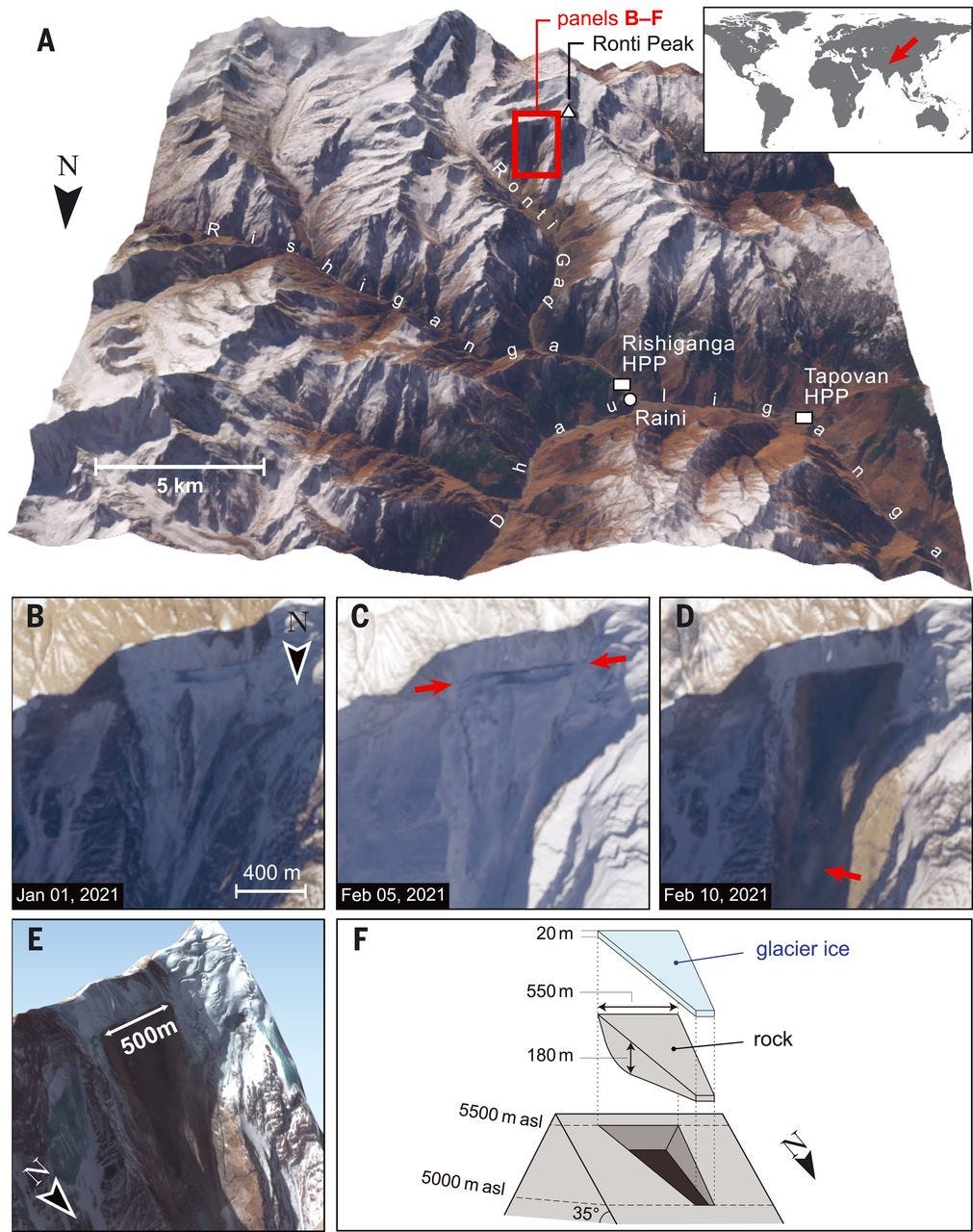
Fig. 1 Overview of the Chamoli disaster, Uttarakhand, India.(A) Three-dimensional (3D) rendering of the local geography, with labels for main place names mentioned in the text. HPP, hydropower project. (B to D) Pre- and post-event satellite imagery of the site of the collapsed rock and glacier block, and the resulting scar. Shown is snow cover in the region just before the event (C). The red arrows in (C) indicate the fracture that became the headscarp of the landslide (fig. S4) [(22), section 3.2]. The arrow in (D) indicates a remaining part of the lower eastern glacier. (E) 3D rendering of the scar. (F) Schematic of failed mass of rock and ice. Satellite imagery in (A) to (D) and (E) is from Sentinel-2 (Copernicus Sentinel Data 10 February 2021) and Pléiades-HR (copyright CNES 10 February 2021, Distribution AIRBUS DS), respectively.
Here’s an excerpt on the climate change question:
Soon after the disaster, media reports and expert opinions started to circulate, postulating links of the event to climate change. Recent attribution studies demonstrated that glacier mass loss on global, regional, and local scales is to a large extent attributable to anthropogenic greenhouse gas forcing (36, 37). High-mountain slope failures in rock and ice, however, pose additional challenges to attribution owing to multiple factors and processes involved in such events. Although long-term trends of increasing slope failure occurrence in some regions could be attributed to climate change (16, 38, 39), attribution of single events such as the Chamoli event remains largely elusive. Nevertheless, certain elements of the Chamoli event have potential links to climate and weather, as described below. Furthermore, the Chamoli event may be seen in the context of a change in geomorphological sensitivity (40) and might therefore be seen as a precursor for an increase in such events as climate warming proceeds.
The stability of glacierized and perennially frozen high-mountain slopes is indeed particularly sensitive to climate change (16). Our analysis suggests regional climate and related cryospheric change could have interacted in a complex way with the geologic and topographic setting to produce this massive slope failure.




Can you relate this kind of activity to the Thwaites disappearance in Antarctica?