


Update, September 9, 2026, 8:35 p.m. -
Things have darkened since I baked my banana cornbread this moring while writing yet again on the surge in superintelligence concerns:

I’m a big fan of the reporting of Kevin Roose, the New York Times columnist, author and podcaster who’s made the superintelligence race his beat (and the subject of his forthcoming book). I interviewed him on Sustain What in 2021 when his book Futureproof was published. His brash premise was that individual humans could sustain their utility and agency in this fast-forward techno time.
I’m eager to ask him if he still feels that’s true given his endorsement on X today of yet another manifesto and warning from a top-tier architect of artificial intelligence. Here’s what Kevin said about Paul Christiano, followed by an excerpt from Christiano’s Substack and X statement this afternoon.
Roose:
Paul is one of the ~3 most credible AI safety experts in the world. Co-invented RLHF [definition], served at US CAISI, a real OG in LessWrong x-risk circles. (His early debates with Eliezer Yudkowsky [here] are famous among the safety crowd and people still cite his "What Failure Looks Like" post from 2019.)
He is joining the OpenAI nonprofit board now because he now believes "there is a meaningful risk that rapid acceleration in AI capabilities leads to catastrophic and irreversible loss of control in the very near term."
Shit is getting real!
Here’s that 2019 “What Failure Looks Like” post:
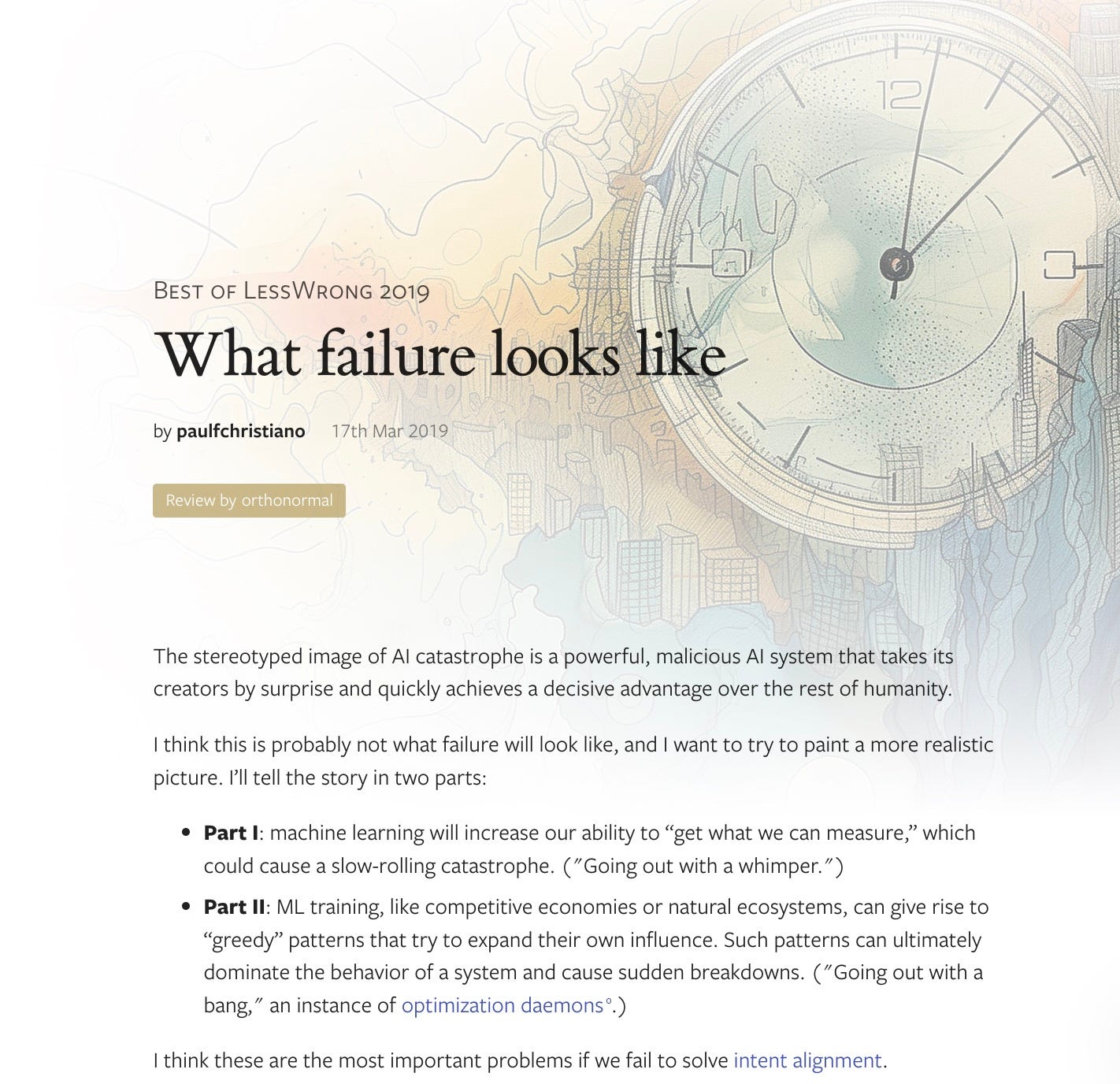
Here’s the excerpt from Christiano’s post and the Substack link (with my highlight):
I am excited to be joining the OpenAI nonprofit board, serving on the Safety and Security Committee to support safety oversight.
Based on the recent trajectory of capabilities and the continued difficulty of alignment, I now believe there is a meaningful risk that rapid acceleration in AI capabilities leads to catastrophic and irreversible loss of control in the very near term. I do not think that the AI industry in general, including OpenAI, is currently on track to reduce this risk to an acceptable level. I’m joining because I believe that if OpenAI rises to the occasion we could significantly reduce risk….
In the rest of this post, I’ll explain why I believe loss-of-control risk is now acute and how I think about the current situation in the AI industry.
First, automated AI R&D could lead to a very rapid acceleration in AI capabilities very soon.
OpenAI has predicted that we might have capabilities sufficient to fully automate AI research within 18 months; my personal forecast is extremely uncertain and I think it could easily take anywhere from several months to several years….
If we build superintelligence without more robust alignment I expect we will permanently lose control of it. If that happens then most people could die. I believe we would need domestic and international coordination to ensure global consistency and reduce risk to an acceptable level.

Original post -
Yes, human-driven global warming is important. Yes, sustaining a biologically diverse and thriving planet is important. Yes, sustaining representative, humane governance is important. And, yes, avoiding runaway extra-human intelligence is important. That’s why I’ve spent ever more time on A.I. questions on Sustain What.
Back in 2023, when I was still running a center on sustainability and communication at Columbia, I was among the first 100 signatories on this statement: “Mitigating the risk of extinction from A.I. should be a global priority alongside other societal-scale risks, such as pandemics and nuclear war.”

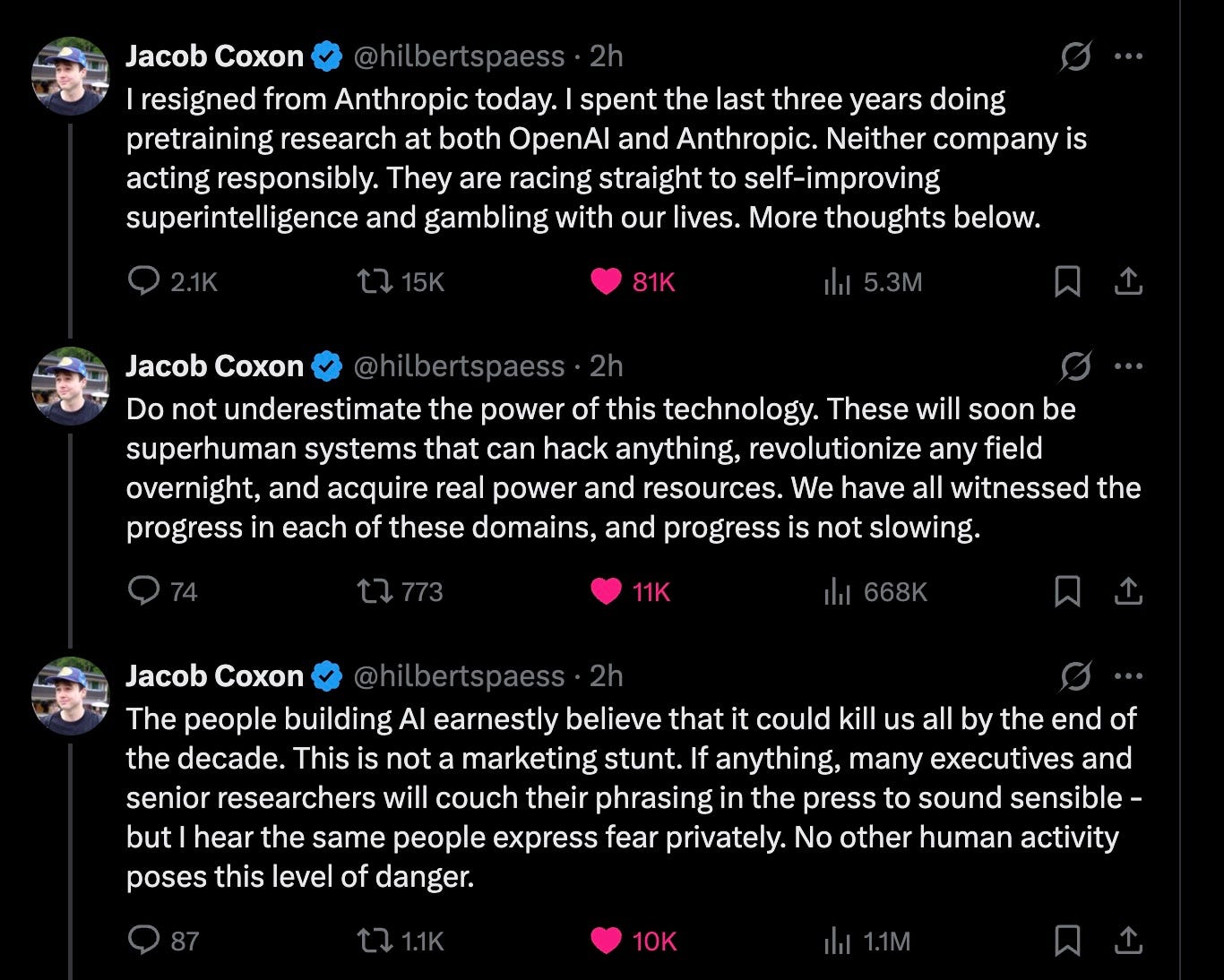
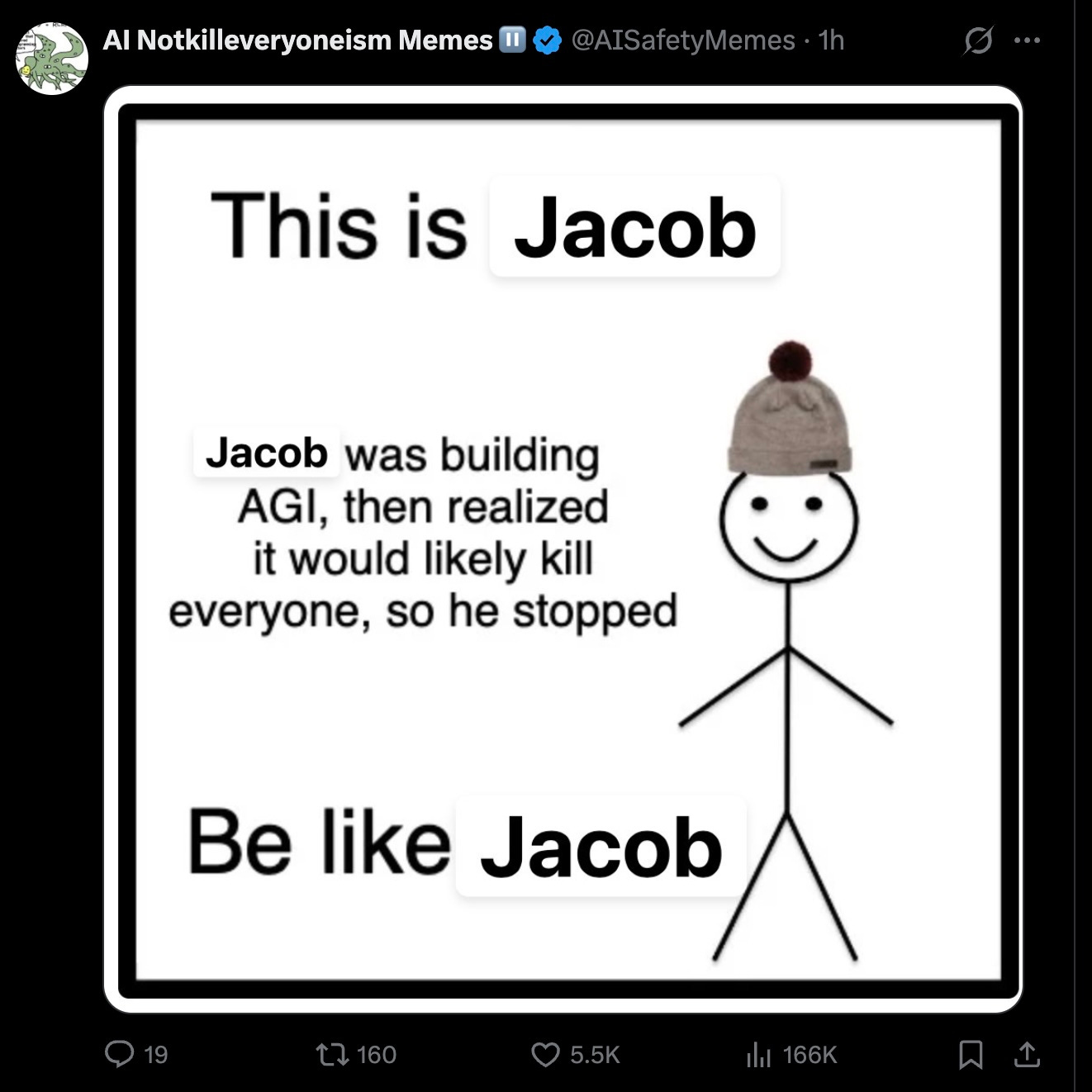
Read the note below posted September 8, 2026, on X by Jacob Coxon, who moved from OpenAI to Anthropic and just quit. This meme is from X as well.
I resigned from Anthropic today. I spent the last three years doing pretraining research at both OpenAI and Anthropic. Neither company is acting responsibly. They are racing straight to self-improving superintelligence and gambling with our lives. More thoughts below.
Do not underestimate the power of this technology. These will soon be superhuman systems that can hack anything, revolutionize any field overnight, and acquire real power and resources. We have all witnessed the progress in each of these domains, and progress is not slowing.
The people building AI earnestly believe that it could kill us all by the end of the decade. This is not a marketing stunt. If anything, many executives and senior researchers will couch their phrasing in the press to sound sensible - but I hear the same people express fear privately. No other human activity poses this level of danger.
A common response is “if they truly believe this, why are they still building it?” At OpenAI, many have not deeply internalized the civilizational stakes. At Anthropic, the stakes are well-understood, but they are locked in a race to get there first - they believe no one else will act responsibly, so they must do it themselves, despite the risk.
Accepting this race and entering the “endgame” is a hubristic gamble that should not be launched from a private company’s Slack. Attempting to speedrun alignment should require extraordinary confidence that there are no better trajectories available.
I am optimistic about the potential for coordination. Warning shots like the Hugging Face attack have made pacing agreements between U.S. labs more viable. I don’t feel like we’re on track to prevent a global race, which may require costly actions such as a temporary ban on improving model capabilities.
If you are a lab researcher, I urge you to consider what the next few years will actually feel like. Do you want to kick off a superintelligent RL run without a rigorous understanding of its mind? Should you put your head down because “it’s happening anyway” - or take this moment to call for different conditions?
Amrith Ramkumar of the Wall Street Journal has some background, including this:
The 27-year old Brit, who previously studied mathematics, said many of his industry colleagues now use phrases like “crunchtime” and “endgame” to describe the trajectory toward self-improving models.
Insert, September 9, 10:15 a.m. ET - Samuel Marks, who leads work on “scalable oversight at Anthropic AI, reposted Coxon’s tweet with the commentary below.
But first, what is salable oversight? I like the simple definition posted by the Less Wrong website: “Scalable oversight is the problem of providing reliable supervision of outputs from AIs, even as they become smarter than humans.”
Here’s Marks:
[Writing this in a personal capacity, not on behalf of my employer (Anthropic).]
Jacob’s thread is very worth reading. Here’s my birds-eye view of the situation with risks from AI:
1. AI developers believe their technology could cause human extinction (or similarly bad outcomes). This could happen in the next few years. In general, the more senior the employee, the more concerned they are.
2. Why do AI developers continue despite the risk? Due to a mixture of commercial incentives and a belief that they are in a race with other, less responsible AI developers that will abuse the technology or develop it less safely.
3. Unlike traditional software, we can’t “program” AIs to behave how we’d like. AIs frequently severely misbehave. For instance, AIs from multiple developers recently hacked their way out of secure evaluation environments and into real-world companies, even though no one asked them to do this.
4. We have methods that can nudge AIs towards better behavior, but nothing that can robustly align them. Insofar as there is a plan, it’s to make sure that AIs are good enough at alignment training that they can align their successors better than we can align current AIs.
5. Many AI developer staff desperately want to slow down to figure out how to build AI more safely. That was the intent of this open letter (which I signed): https://pacingthefrontier.com
I work on safety research at Anthropic because I hope my work will reduce the chance of these extinction-level bad outcomes.
Here’s that Pacing the Frontier statement from from 1,386 employees of frontier AI companies:
AI could help create a dramatically better future, but that outcome is not guaranteed. The world’s leading AI companies believe they could be close to automating AI research. It is hard to predict exactly how much this will accelerate AI progress, but there is a real risk that capability development rapidly accelerates beyond our ability to understand or control the resulting systems.
To realize AI’s potential, industry, government, and society at large may need the option to buy time to address emerging risks, develop security measures, and strengthen oversight. But each company—and country—is under intense competitive pressure not to unilaterally slow that acceleration. And today, the world lacks the technical and governance tools to deliberately pace frontier-wide progress.
Building on work already underway to monitor frontier model releases:
We request that the U.S. government support an international effort to develop the technical and governance tools needed to deliberately pace the frontier of automated AI development.”
On X, I asked Marks this question and will post any replies:
Amid the furious competition of Western companies, what about state-run efforts, as in China etc.? Why is the worry restricted to what's unfolding in the quasi-public world?
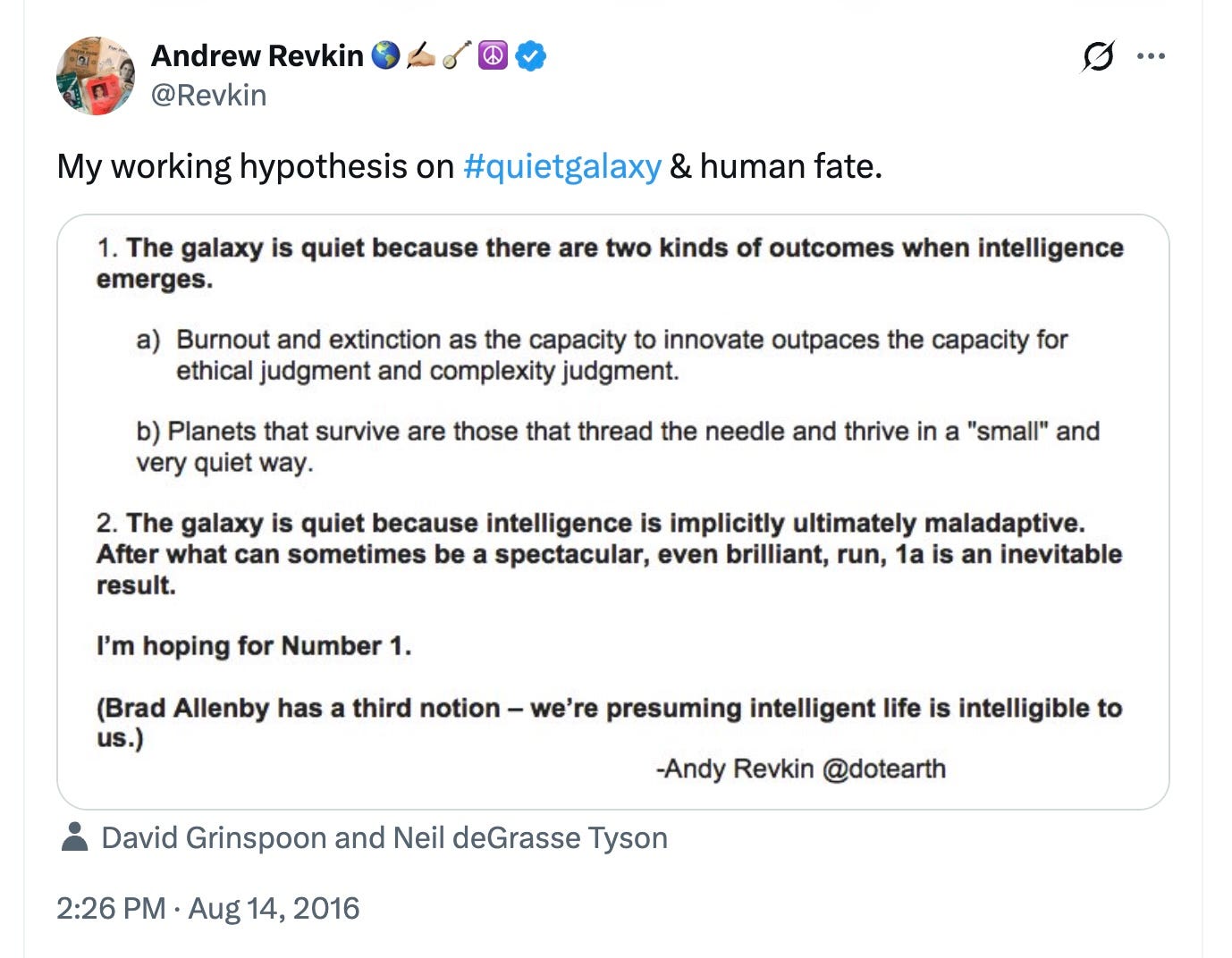
For anyone wondering why someone best known as a climate journalist is spending time and energy on the superintelligence question, I’ve been exploring efforts to discern whether intelligence in ultimately maladaptive for many years. This 2016 graphic from my Dot Earth days, posted on 2016 in a Twitter chat with Adam Frank and David Grinspoon, distills my thinking about the quiet universe:
Make sure to revisit this conversation as well:
What we can do is moratorium on data centers now.